
Body Image Struggles Aren't a Mindset Problem
Telling someone to ‘just opt out’ of diet culture is no different from telling people to eat less and move more.
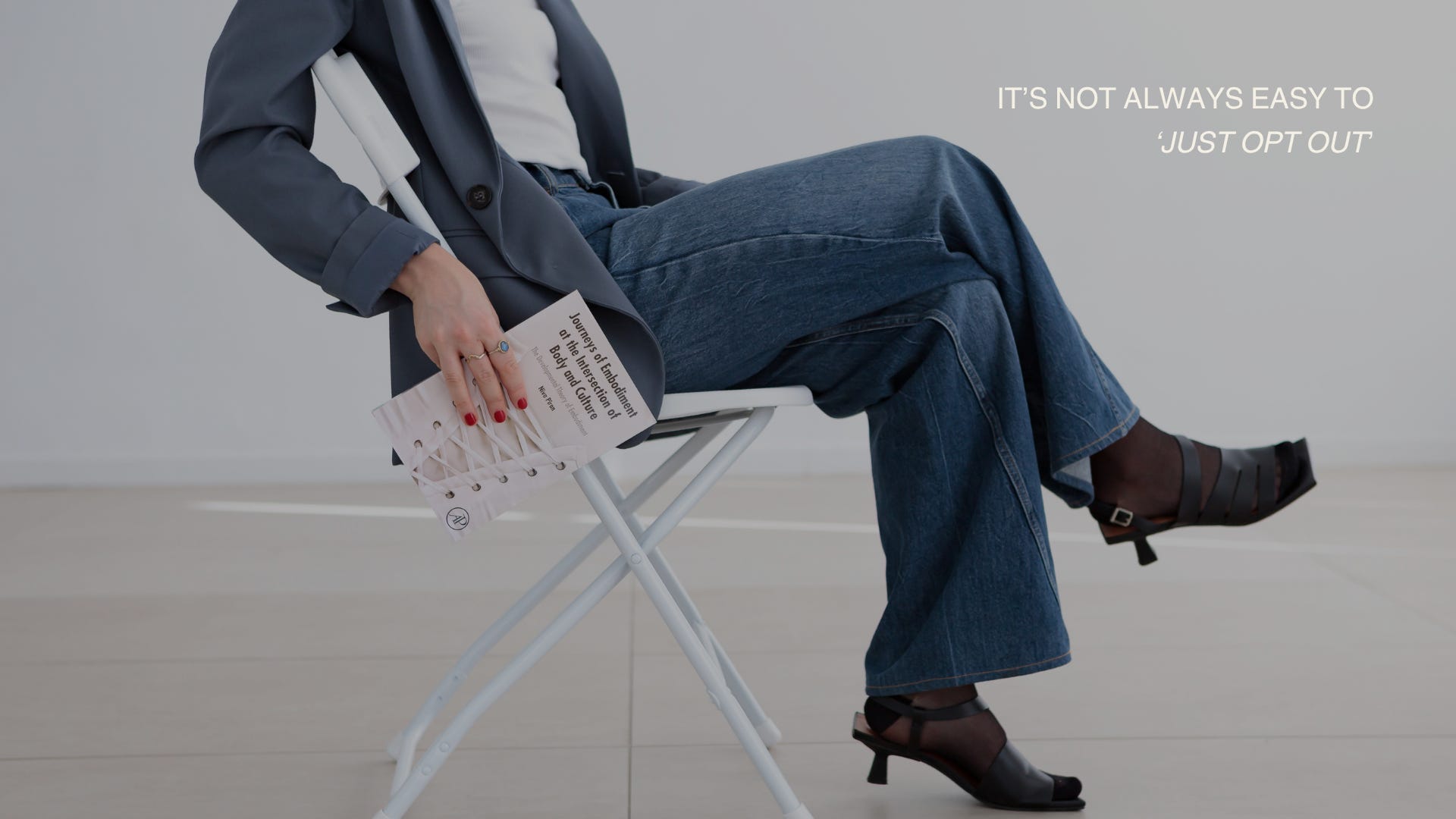
Have you ever tried to opt out of diet culture?
I come across this messaging constantly, particularly fitness accounts and body positive creators, encouraging people to opt out of the idea that smaller bodies are better bodies, and focus on strength instead.
Great message. I am all for empowering people to live bigger lives.
The question is: how do we actually do that?
Simplistic messages like:
‘This narrative is optional, just ignore it’
‘Your weight isn’t your worth. You have the option to opt out any time’
‘You are one decision away from choosing strength and loving your body!’
…miss the point entirely.
No one is waking up each day and choosing to feel shit about themselves.
And look, maybe for some people, a reminder that ‘there is more to you than how you look’ is enough. That’s all the encouragement they need to stop exercising to be skinny, pick up strength training, and focus on a life beyond their appearance.
But what I hear most often from clients is this:
‘I know society creates beauty standards to sell me things I don’t need. I actively encourage others to celebrate what their bodies can do. And I’m exhausted from pretending I don’t care about how I look, because I do.
And they feel ashamed for admitting it. Why can’t I just get over this already?!
Here’s why.
Your relationship with your body didn’t start with diet culture, widespread misuse of ozempic, or the seemingly endless pressure to bounce back, stay young, accept your body, and be strong (not skinny!).
Your relationship with your body is a reflection of your relationship with yourself.
And your sense of self develops much earlier, with your earliest relationships. If those relationships made you feel like you belong, you’re welcome as you are, your needs are important and respected, then you are much less susceptible to internalising appearance pressures.
Not everyone has that experience.
People who experience body image struggles despite ‘knowing better’ have often grown up with chronic criticism, emotionally distant caregiving, or praise that was always conditional on being good, capable, helpful, and easy.
These experiences shape how your emotion systems develop and impact how safe you feel in connection with others. This can be hard to trace, because what’s missing rarely leaves a clear mark. You don’t know what’s missing until you finally receive it.
It’s like eating Thai food in your hometown vs taking a cooking class in Chang Mai. Wait, that’s what it’s supposed to taste like?!
A low sense of safeness in relationships is associated with higher shame and more frequent appearance comparisons. This can fuel disordered eating, which may look like restriction and rigid control, or zoning out with unwanted eating that leads to weight gain.
To top it off, this is often followed by a cycle of self-blame: this was your doing. You have no one to blame but yourself.
It’s exhausting.
We’re also forgetting that body image struggles rarely occur in isolation.
They’re often symptom of a broader pattern of not feeling good enough, and tend to go hand in hand with:
Over-functioning at work
Struggling to ask for what you need
Harsh self-talk you’re too tired to keep arguing with
Constantly worrying what others think
Carrying the emotional weight of your relationships
Difficulty with real intimacy, even in long-term partnerships
And the relentless pressure of: you should be trying harder, why can’t you just do it already, no one else seems to struggle with this…
This is why you can understand that beauty ideals are manufactured, and still feel like your body isn’t good enough.
You can know restriction doesn’t help you, and still feel the pull toward it when things get hard.
You can long to feel more like yourself, and feel ashamed for desiring weight loss when you’ve been told that you shouldn’t.
It’s not something you simply choose to opt out of one day. And framing it this way is just another version of: try harder.
I work with intelligent, driven people who are already trying hard. They’ve spent years ‘doing the work’, going to therapy, reading the books, and journalling their thoughts. The last thing they need is to have their struggle minimised, and their intellect used against them.
I believe in agency, recognising how these patterns play out, and taking charge of cultivating the feelings, relationships and life that we want.
But let’s not make out that it’s easy.
Thinking differently is not the same as feeling differently. You can’t intellectually override a lifetime of subconsciously believing your needs aren’t important, or suddenly ‘love’ a body you’ve learned to disconnect from.
So if you’re reading this because content telling you to ‘just opt out’ sparks frustration…
Good. I’m glad you’re angry.
That anger is telling you something is missing from these messages, and you’re right. It’s telling you that you deserve support that goes beyond mindset reframes and honours the complexity of what you’re actually dealing with.
Truly improving your body image, maintaining a stable weight, and ultimately being free to fully enjoy your life…
Requires building a different kind of relationship with yourself.
→ Establishing regular eating patterns and increasing food variety.
→ Rebuilding your connection to your body and your senses with pockets of presence, breathing, imagery practices. Experiencing your body from the inside-out, rather than the outside-in.
→ Noticing emotions that are pulling you away from the eating and movement patterns you want to adopt, or driving the patterns keeping you stuck. Building tolerance over time, and working with them rather than living from them.
→ Connecting with your compassionate self, and working with the fear of falling behind and letting yourself go.
→ Getting to know your inner critic. Not ignoring, fighting or arguing with it. Being curious why it’s there, and what it needs.
→ Actively cultivating an identity that doesn’t hinge on how useful you are, how much you’ve achieved, or how well you’ve managed to suppress your needs.
→ Asking hard questions, like: who are you when you’re not working? Who are you when you’re not supporting others? And committing to finding answers.
→ Experimenting with your personal style: how does the bold, open, playful version of you dress?
→ Building community that welcomes you for who you are, not who they need you to be.
For someone who learned early that other people let you down, overly simplistic messaging can reinforce the belief that you should be able to figure this out yourself, just like you do everything else.
You don’t have to.
You can be strong, capable, AND possess a human brain that was built to thrive in connection with others.
Far from an admission of weakness, allowing yourself to be supported is a commitment to what you really want from your life.
If you’d like to explore working together, you can reach out here.
P.S. Instead of letting my inner perfectionist run a million edits, I decided to say fuck it and hit publish on my first Substack post. If any part resonated with you, I’d love to know!
The science that shaped this:
Baumeister RF, Leary MR (1995) The need to belong: desire for interpersonal attachments as a fundamental human motivation. Psychol Bull 117(3):497–529. doi:10.1037/0033-2909.117.3.497
Depue R, Morrone-Strupinsky J (2005) A neurobehavioral model of affiliative bonding. Behav Brain Sci 28:313–395. doi:10.1017/ s0140525x05000063
Ferreira C, Pinto Gouveia J, Duarte C (2013) Physical appearance as a measure of social ranking: the role of a new scale to understand the relationship between weight and dieting. Clin Psychol Psychother 20:55–66. doi:10.1002/cpp.769
Ferreira, C., Silva, C., Mendes, A. L., & Trindade, I. A. (2018). How do warmth, safeness and connectedness-related memories and experiences explain disordered eating?. Eating and weight disorders : EWD, 23(5), 629–636. https://doi.org/10.1007/s40519-017-0449-y
Gee, A. & Troop, N.A. (2003). Shame, depressive symptoms and eating, weight and shape concerns in a non-clinical sample. Eating and Weight Disorders, 8, 72-75.
Gilbert P (2002) Body shame: a biopsychosocial conceptualization and overview, with treatment implications. In: Gilbert P, Miles J (eds) Body shame: conceptualisation, research and treat- ment. Routledge, London, pp 3–54.
Pinto Gouveia J, Ferreira C, Duarte C (2014) Thinness in the pursuit for social safeness: an integrative model of social rank mentality to explain eating psychopathology. Clin Psychol Psychother 21:154–165
Schore AN (2001) The effects of early relational trauma on right brain development, affect regulation, and infant mental health. Infant Ment Health J 22:201–269. doi:10.1002/1097-0355(200101/04)22:13.0.CO;2-9